The 40 bits

It is said, scientifically that our brains are processing 4 billion bits of transactions per second. Out of these 4 billion we are consciously aware of only 40 bits at any time. Just 40 bits. The whole body working, the awareness of mind about it’s surroundings, everything is taken care without even us being aware about it.

It’s a very efficient design. Our mind gives us exact information we can process (if we mind gives us info to process – who is processing? That’s another blog post). But, as you can make a guess there is amazing amount of info that is being either discarded or filtered. And this is not always a good thing.

40 bits is our cognitive upper limit. 40 bits is metal awareness limitation. This in-place limitation affects our daily life. We tend to think that these 40 bits are “The Truth”. And over a period of time these Truth’s are turned into Beliefs and belief systems. All this happens even without our knowledge. These 40 bits are the thin veneer pulled tight over our eyes.

Just because we have a limitation, it doesn’t mean we can’t break it or over come it or at least use it smartly. Here is where the Creativity process comes into picture. There are 2 steps to over come this limitation.

  1. Becoming aware of it
  2. Replacing, reusing the 40 bits

1. Becoming aware of it: I have talked about this here, here and here. I don’t want to go into more details, but the gist of it is – you need to be aware of your own thoughts. The inner chatter that happens is where all the action lies. There are a bunch of ways to become aware of it.

  • Just being still
  • Being in the moment
  • Meditation
  • Being in Nature
  • Taking a stand whole day – Like “I will not judge anyone or anything all day today” and keep watching yourself over that stance.

Recently I have came across a great book which does this process but with Questions. It’s Byron Katie’s ‘The Work’. It’s a very simple 4 questions inquiry process which is tremendously powerful once you start to use it. I would highly recommend that to adopt a inquiry process if you don’t have time to meditate. Another thing you could do is to read ‘Bhagavad Gita’ every night. I know I sound so totally Hindu here. But, I am recommending Gita not from a standpoint of religion but from the point of view of Philosophy. It drums this whole thought system which, if used, is very powerful. I would recommend Jack Hawleys – Bhagavad Gita for Westerners (not much on mythology and a small book)

2. Replacing, reusing the 40 bits: Well this has been my day to day thing all my growing up years. I always thought that there exist some system out there by which we can be more creative. I have ready and used many many systems – but the whole idea behind it is – you need to stretch out your mind by opening yourself up with new information. In this age and day there is no dearth of information – but if you always seeking the same info- they you are always keeping the same info in that 40 bits you got.

So, 2 books come to mind. Any book by Edward De Bono – he might come out as dry and simple. But trust me try the tools. Another one is by author Dan Roam – He has a visual problem solving framework. His books are here and here. The advantage of using a visual model as compared to textual model is you can put those 40 bits to maximum use. Like if you draw a picture – you can refer to it probably using just 1 or 2 bits – like a pointer for all those computer guys.

I know it’s not easy being aware of our own 40 bits. Awareness is scary and processes are hard. But again it’s something you do on a long term learning basis. You can’t get this done faster. It doesn’t work that way.

This concept of Manifestation

If you are like any other normal person you would have seen a flurry of many many new-age gurus talking about Manifestation and how we are in control of our lives. The idea is not new but the packaging is. It used to be learned, used and followed by a bunch of off the track people in an alternate universe – but The Secret -movie, bought it to the mainstream.(You should also check out What the Bleep do we know? – more real and scientific) Quickly the gurus in the movie turned their back on it and started propagating how ONLY they understand the Secret. The main concern of the people who don’t like Secret is – that it’s too goody goody and non-actioney. The Secret doesn’t talk a lot about the action that needs to be done to achieve what you want to achieve. I totally agree – but hey, don’t shoot the messenger.

I have been, like any other person, curious about this idea for quite some time. My personal freedom and my personal creations are extremely important to me and I believe in the concept of being the person who is in charge of my own reality. I have been reading up quite some books on this concept and this blog post is all the that information filtered to my understanding.

The beauty of belief is – everyone tends to create, see and do what their belief systems dictate. So, based on my beliefs – the way I understood it could be totally off from what others see. This is just my one opinion in the million out there.

The (Hi)Story:

This goes back a little. The way I grew up – was in a patriarch family where my dad called shots on everything. Just like most Indian families. For various reasons and causes, I grew up to be an extremely shy and awkward teenager (who didn’t?). When I turned 20 – I decided that I need to change myself. In someway. I didn’t know what to do. I have been scared of Public Speaking but enjoy the whole process of someone taking the stage and entertaining a crowd. So, I thought I will have to face my fear and then I will be fixed! Little I knew about the arduous process of self-change.

I joined a Leadership Training program which was taught by a Genius who was also a chain smoker. Good start eh. Over the period of next 3 months I faced situations where I almost peed in my pants, cried many many times and embarrassed myself. I wouldn’t want to go on stage at all. It was really hard. But in the end, I ended up becoming aware of 2nd things – 1. The power of my mind., 2. I am still going to be shit scared of public speaking!

Things moved on, life happened. The literature I was exposed to made me learn more and more about other self-help books. I started to form a basic model of how this works in my mind. Fast forward – 2003 NYC. I was taking Yoga classes at Sivananda Ashram. In one class the teacher, talked about how our mind is a powerful tool and how it could manifest things that our belief system tells us we can’t. It stuck with me and I was looking for an opportunity to put it to test.

Somehow, by turn of fate one day I ended up standing in line for tickets to see ‘Rent’ on Broadway. They usually have a raffle before the show to give away free tickets to the very few.(It’s actually the first two rows – which are actually the ‘spit fire’ lanes!) Now, I used this “mind over matter” theory to see if it is true. For the next 30 mins – I did everything I could – thoughts wise, feelings wise, emotions wise, images wise, actions wise, behaviors wise etc – immerse myself into defeating my belief system that I have won the raffle and free tickets. It was not easy to convince my beliefs and it looked stupid to try that. But I kept it on. The third name they called was mine! Now I know – those skeptics who are reading this – it could totally be a spooky coincidence. I agree. But it didn’t matter to me. I don’t think I was so ever shocked in my life like I was then. Literally shaking. I didn’t even watch Rent properly. One thought kept pounding in my head – What else can I do?

The Concept:

So, here I am trying to take this blog post as an opportunity to kinda cull my learning into one small piece. Since I usually think better with drawings and visual aids, I am going to draw a image which comes to mind.

Concept of ManifestationThis looked far better when I drew it on a paper. Graffling is not my skill. So, I want to explain the numbered points:

1 – Mental State: This is your present mental state. At any given time there are so many thoughts, ideas, images, sounds, smells etc belong to this mental state. You can leave it as it is or you can organize the mental state. This is the origin. Whatever exists here is converted to reality in some form or shape by the vibrational state. We do have control on this. The inputs to Mental state are

  1. 5 senses
  2. Internal talk

2 – Vibrational State: I talked about this in the past. This is the state we have no control over. It’s like the inevitable fact. Nothing we do can change this – directly. However, the only way you can make use of this state is to influence upon things indirectly. How? Through the mental states. So, like the candle light is reflected in a mirror – the vibrational state just mass produces anything that the mental state gives.

3. Beliefs: These are the filters. Affecting what is fed into vibrational state as well as what goes out of it. If you have way too many filters then – there is nothing much passing through – meaning, your mental state doesn’t match your reality and vice versa. We have control over this. We can become aware of them and start dropping them off. The more we clear and select our beliefs – the more mental state matches the reality. Of course we will have to start with the primary belief – we can change our reality.

4. Reality & Results: As vibrational state outputs – they come out of us as actions, behaviors, words, theories, ideas etc. Again these are filtered by our beliefs. Depending on how our beliefs are structured – we act, think and talk, there by resulting in our actual reality.

That’s all to it. That’s the manifestation process as I understand it.

The Strategies:

Knowledge is useless without application or action. So, how do we turn these into personal strategies? Here are some of my thoughts:

1. Objectives and Goals: The reason why a lot of people ask and talk about setting goals is – getting clarity about what you want is half job done. In this model – it would apply to the ‘Mental State’ stage. Just writing down all the goals and setting timelines (realistic) is the first step.

2. Meditation: This might sound odd for Manifesting theme. But what meditation does is – it basically lowers the resistance of our beliefs for the time we meditate. I talked about a meditation method in my previous post. So, let me break it down a little in detail. You do meditation for 15 mins every day. Those 15 mins, you try to concentrate on your breath. It’s hard but with practice you will get to stage where you can do that. When you focus on your breath – there are 2 things happening: 1. Your thoughts are being ignored or not given major attention. 2. Focusing on breathing – streamlines it. Slowly after 5 mins, you will notice you are breathing deeper and longer.

This in turn gets you into something called ‘Alpha brain waves‘ – which is a very productive place to be. In that place your resisting guard would be let down and since you already placed your goals and objectives in your mental state prior (through daily goal setting etc) these would be easily conveyed to your Vibrational being which creates actions, ideas and behaviors in you which create your reality.

So, the meditation actually is doing a lot of things under the hood without our knowledge.

3. 21 day habit swap: In his book Psycho-Cybernetics – Dr.Maxwell Maltz originally talked about this 21 day theory. Basically Dr.Maltz was dealing with people who had their body parts removed for various reasons. Some people who lost their arm would still feel pain in it, even though there was no arm. And it usually took 21 days for patients’ body to get over the pain and come to an understanding of new reality. This vital info could be used to form new habits and change how we view and create reality.

Once you set goals – you could start working on them and trying to be consistent for at least 21 days. Most of the time it works. After 21 days, it would become natural for you to work on the goals & tasks.

4. 68 seconds rule: I have no idea why that number – but it’s like number 42 – the meaning of life. If you can manage to do this, it could create some wonderful results. Basically it goes like this – any thought, strongly held for 68 seconds would kick off major changes in your reality. My logical mind doesn’t understand why? I have no data on it – but it has worked for me in various occasions.

So, that’s my understanding of this concept of Manifestation and some strategies involved. I am willing to look at any other info you have to offer to me. But in gist it’s how I understand and it has been working like that for quite some time for me. Please remember – no theory is correct or accurate. We are all blind men groping the Elephant!

Be easy on yourself, play with different methods and most important of all – enjoy the ride, even if it means you are scared of Public Speaking.

15 minutes of Meditation

Recently, I have started to consistently meditate for 15 minutes every morning. I do miss those good old days where I used to meditate for an hour, now a days stuck between Conference calls and morning emails – it has become more of a luxury. So, I decided a new practice of just 15 minutes every day after I take my shower. There are many many ways you can meditate – but the one I follow is simple process of watching my breath. Here are some things I found out and wanted to share with everyone.

  1. Expect roadblocks – it’s like the whole world is conspiring against you to stop you from meditating. You will have a work emergency, someone calls and something obviously breaks down.
  2. Expect Physical uncomfortableness – Your chin would itch. You might fart. Your stomach would grumble etc. Please don’t try to stop it. Just become aware of it.
  3. Expect Crazy thoughts – in like 5 minutes you will start to feel like, you have been meditating for 15 years. You would be like “Enough Already”
  4. Expect random and crazy thoughts – It’s like your mind (actually ego) gets trapped in a box and starts to throw around all those fears, crazy thoughts etc towards you. Don’t panic. Just come back to your meditation, by bringing your focus back to your breath.
  5. Perfection – This is the single most reason why I stopped meditating in the past. I was like, if I can’t be perfect and meditate for 1 hour – I don’t want to do it for 15 mins. There is no logic behind that thinking. Except that my Ego has trapped me into this paradox where I want to meditate, but because of my perfect scenario not available to me I refuse to do it.
  6. Failure – There is no failure. It’s a mental construct. You can’t fail at this. No one is watching you. No judgment. There is not single way to fail at this. However if you do it consistently, you will get better and better at focusing.

This is what I have observed once I start to be consistent in it:

  1. I am more poised during the day
  2. There is this point of view, which is hard to explain but easy to experience – which gives you an ability to watch yourself.
  3. I started noticing stuff which I never did. My beliefs, values. Most importantly my thoughts.
  4. You would get this Big Picture view of anything where it becomes easy for one to see where all this fits in, in the big picture.
  5. All the trivialities sort of start to fall off.

I am no expert at this, but just 15 minutes of my day affects so many hours of my waking life. That’s all I know and that’s all I want to do at this time. I won’t let Perfection stop me from being good.

2 Absolutely Necessary Qualities in an Offshore Team/Member

After a recent event – where I ended up working all day Saturday, I have been thinking a lot about Offshore developer/teams and Onsite Clients’ requirements. Having worked on the other side where the Client looked down upon us for every little mistake – but couldn’t let us go because it doesn’t get any better – I have realized couple of things.

Here are 2 absolutely necessary qualities that I would expect in any Offshore development team or member.

1. Escalate: Offshore development kinda happens in future. I mean the timezone wise they are always ahead of us. This needs to be used as an advantage. Whenever something goes wrong or something doesn’t work – the Offshore team needs to escalate it to their Clients Onsite. This helps the Client to take necessary action even before this issue turns into a roadblock.

I am not sure of any other country, but of what I have seen mostly in India. So, these observations are based from my Indian work experience. It is such a strange medley of opposites and paradoxes. Indian developers are very smart to grasp technical ideas but their smartness fails them when it comes to communications. From the childhood, most Indian parents encourage their kids to become class toppers (Believe me, topper is a household word there, I was once a topper too.). There is no emphasis on clear communications. Parental authority in the initial stages and later work based hierarchy system actually supresses any communication abilities a person may have.

The end result is – a brilliant mind, but a numb tongue. So, if only the developers or the team members can learn to voice their opinions much more vocally – we would not have so many issues. Escalate problems as you see it. Raise red flags whenever you can. Your Onsite manager is not your Dad, he won’t be mad at you or judge you for bringing up a problem/issue.

2. Proactive: Most Indian developers I meet are reactive in their approach to development. If I give them a problem they will solve it based on their knowledge. But life doesn’t come in neat packets of problems. It’s a big mess that just overwhelms you.

Being Proactive means, anticipating delays, anticipating what might come up and prepare accordingly. It is said that only 300,000 years ago Humans developed – Pre-Frontal Cortex, the area under your forehead which gives us the ability to simulate any situation just by imagining it. Prior to that, we had no clue of any experience which we have NOT faced it physically. Just imagine how important this is. We got a whole extra add-on. We got a simulation laboratory right in our heads. This gives any human to use Imagination to try to simulate things, situations, actions, behaviors etc without even physically experiencing them.

So, developers – please put that to good use. Use that 1/4th of your brain to basically see the future. It’s something everyone does without being observant. It’s called day dreaming. When you are dreaming of that beautiful girl sitting in front of you in a Coffee shop or when you are dreaming of that vacation you have been wanting – all these things use your frontal brain. So, next time just use it in your projects to fore see what would happen if you did something and what possibly could be your response to it.

An example: We setup a stage server and I asked the developer to add some changes there and test them. He made his changes, but when he went to test them – the login didn’t work. So out of habit of his reactive mind – he assumed that he is powerless and basically sent out an email to me (from the future) telling me that the login doesn’t work. Well, you are the developer – if login doesn’t work then you gotta fix it. That’s what I did. When he said, the login didn’t work – I debugged it and figured out what was happening and I fixed it. The only difference between what he did and what I did – is not technical, but psychological.

That’s all. I don’t want any more features in my developer from India. I don’t care about your sex, about how you look, about your skills, about your coding powers etc. All I need from you is – A good red flag raising capacity and the ability to fore see them coming.

That would save the whole industry of Offshore development from using double the bandwidth in communications – back and forth.

Contemplation and a song

Today I was talking to a friend and our conversation went into past and something happened along those lines where I suddenly became saddened. It took me a while to realize what had happened and usually I would run away from the feeling – this time I tried to stay with it to see what message does it bring. It made me more sad but it made me contemplative. As I was thinking, one song kept playing in my head again and again. It took a while to locate that song in my head as it’s been long time I listened to it.

I couldn’t locate the lyrics for the song but only a video on Youtube. It has a deep meaning (Sorry folks, you need to know Hindi to understand this – I don’t think even a translation would do justice) and Asha Bhosle just strung the chords of my heart.

Self-Branding through Facebook

I want to talk about how Facebook has replaced our personal public branding (especially for the individuals, more for the companies in a later post) and how people are benefiting from it and how some people are losing out.

To explain this, I want to talk about 2 stories.

1. Facebook Usernames : Have you gotten yours yet? If not, you missed the maddest digital namespace gold rush one can ever witness, it happened last Friday. Facebook announced couple of days back they are going to be assigning Usernames to their users. You may wonder how they have been working without one so far? Well, they do have user numbers so far, and an email address is used for authentication. Now, this username would appear in the url(A prominent digital real estate). Something very very important – because not only Google would index that url and store it forever into the future but this would be an one stop shop for everyone else on the net to get any information about you.

500,000 people registered for their name in the first 15 mins of opening the gates. Over the weekend over 6 million got their names. That’s just mind boggling numbers. I believe over a period of time Facebook has grown from “I-know-these-people” to “This-is-how-I-Brand-myself” system. Having 1000’s of friends is no longer cool. But what you have in common with them and what you do differently from them is cool. Taking those millions (often annoying) tests, quizzes is not just killing time but defining and stating who we are with respect to those results that these Quizzes produce.

Facebook has grown from a bunch of PHP files to a huge Platform, a eco-system where 3rd party developers can add in their creativity and build applications for the user base of FB. This means, a million ways I can differentiate and make myself unique and branded in my own style. All this would be done under your account of Facebook. Pretty soon – FB would be the standard profile you would be giving out to people (The fine grained settings of who sees what – would keep on growing).

I am more convinced about this because I observed a shift with two services I use with respect to FB.

Flickr: Long time ago, I created a Flickr account. I have about 15GB of pictures, most of them should never see the light of the day! But I was under the impression that I should load up all my pics onto my Flickr(pro) account and believed that “they will come”. Well, I got tired of uploading them half way through and my picture gallery hallways were lonely and haunting. This was even before FB was around. Then came along FB. People started to add their pictures to it. Now it becomes interesting because you can tag people in it and sometimes if you have really old pictures, you can embarrass them too. Jokes aside, what this did was – I filtered out my pics (not all 15,289 pics need to be on Internet) and I put out pics which are meaningful and somehow enables participation of my friends. Along the way what I am also doing is – I building a public self-image.

Twitter: Twitter, as you all know is the bomb diggity of anything that has ever been invented. Or that’s what we are told. I think twitter is a very un-disciplined system. You have many followers, but they are not invested, may be interested but not committed to you. Usually the Twitter stream gets updated pretty fast and it’s hard to keep track. So, over a period of time followers develop ‘follower forgetfulness’ – which basically means I follow about 4000 people and I don’t really care what they do. And as for the leaders on Twitter, they wouldn’t stop with their thoughtful posts but they would post before, during & after they have been to a restroom. This leads to ‘Twitter Clutter’.

Enter Facebook. What Facebook provided to Twitter is “Context”. Under FB’s aegis it was relayed to my friends rather than my mindless million followers. This helped me to further my message to my group of friends. To brand myself with certain thinking.

Don’t get me wrong about Flickr & Twitter. I love both these services, I just think as more and more FB becomes successful at being our Digital Home – Flickr is predominantly going to be used as a photo backup system and Twitter will predominantly be used as ‘News’ relayed in real time system. Imagine what happened in the case of Iran elections. Because of Twitter we know a lot about what happened in Iran in real time. And as time progresses it might end up being used a lot by news agencies, marketing agencies, celebrities, tech celebrities etc. I know a lot of people who use Twitter to relay their company’s message and FB to relay what they personally think.

So, anyhow how all this is connected to Facebook name madness? Because, like I mentioned it’s going to be indexed and linked on major search engines. These usernames will become your visiting cards, persona, branding machine. As for me, I did my share in participating in this madness. At 9:20PM I sneaked out from a bunch of friends visiting us, having a heated debate about Spirituality and registered my name. I am reborn from fb/644977146 to fb/akbarpasha. My new self-branded digital home. People with common names & who delayed were disappointed.

2. Facebook Laggards: I am pretty sure many of us have at least 1 friend who defies Facebook gravity, who refuses to join Facebook and calls it a waste of time. I am very much embarrassed to say that my best friend is one of those guys. Because he is not connected to anyone of our classmates, he is completely out of touch with our group of friends. The only friends he know or keeps in touch are the ones in his iPhone – that’s limited by his talk time & available minutes.

Facebook Laggards are missing out on their digital branding. It’s not just about keeping in touch anymore. There is more to it. My friend doesn’t participate in what’s happening in our little FB world. He doesn’t know how and what our buddies think now 10 years later after we left our MBA school. Many have moved onto do pretty cool things, but my friend is not aware of any of it. He lives in a digital desert. His imagination limited by his phone book. What more can I say? He moved to Alabama, became a hardcore conservative (Republican!) and is a fan of O’Reilly show. Gasp.

But as time progressed – I kinda became his window to our Facebook world. Everyone sends a message to me about him and I get back to them about him. I sort of turned myself into his branding manager.

So, if you have any friends who are refusing to join Facebook on the basis of not being part of the herd mentality – please tell them that it’s more than just address book with pretty pictures. It’s the future digital brand, a identity.

(Re-published here with permission from Clear Night Sky)

An Outsourcing Model: Google Style

We all know what Outscourcing is. It’s was and is one of the hot topics in the past couple of years. I have worked on both sides of Outsourcing – onsite, offshore. The one year I spent in India, I was working on the side where all the magic happens. Where the milestones are turned into code. I have worked on US side where I was churning out milestones for people who were working on my projects in India. Having seen both sides of this model, I have a opinion as to how we can approach Outsourcing and doing it really well.

Recently, Google came out with their definition of what they think a Cloud computing means. Btw, if you haven’t given a thought to Cloud computing you should. The future will be a mix of highend computers tapping into APIs of clouds and trying to keep the core set of data which is meaningful to us in sync. It’s like spreading the peanut butter equally across the bread so that when anywhere you bite into it, you get the same taste. All your devices will hook itself into “The Cloud” and you will have access to the data anywhere you want.

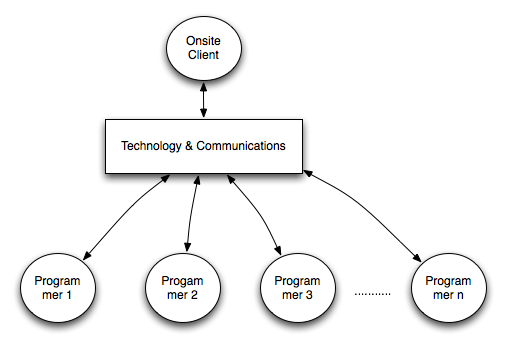
Anyhow, I am not here to talk about Cloud Computing. You need to follow these two people to know more about it. Werner Vogels and Steve Wright. I am here to talk about how Google’s idea of cloud computing can be applied to Outsourcing. I have been thinking a lot about outsourcing since I have been managing couple of them in the past few months. I ran into so many issues in these projects, now I think I have a idea how to get this to work properly. To get the outsourcing work you need to have a very good combination of Technology, People and Communications. Let me draw a simple picture to illustrate.

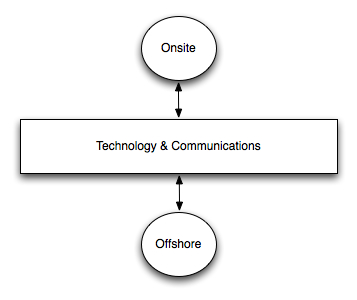
Big Picture: Outsourcing.

Both onsite & offshore has people who are interested in trading skills & profits. In this pic, no matter what kind of role each party plays, the most important part is going to be the middle one – Technology & Communication. So, what is Google’s approach? In Google’s approach – I meant the way Google approaches it’s Cloud architecture. Google has a inverted tree structure when it comes to running it’s cloud or search. It has this major goal at the top and then bunch of extremely well written programs & cheap disposable hardwardware at the bottom. Once again, let me draw a picture.

Google's top down approach

The most important thing in this picture is – the bottom layer of machines is highly disposable. Google uses cheap hardware stripped down to it’s minimal and they all run some custom version of Linux and if something happens to the machine and it dies, the middle part is smart enough to discard that machine and keep working. The middle part has a smart controlling mechanism, where a sigle failure in the system doesn’t halt the whole system. Now, if you imagine the scenario with outsourcing and if you have worked in an outsourcing project – you would have an idea as to how volatile the offshore programming jobs are. In India, I have seen people switching jobs just for another 100$ more per month. The attrition rates are too high and companies do crazy things to keep their employees on board, such as – bonds, contracts, promise of sending the programmer to US in 1 year etc.

So, this is where I got to thinking as to how I can apply the Google’s approach to Outsourcing. Let’s elaborate a little more on our initial picture of outsourcing.

Outsourcing Model: Take 1

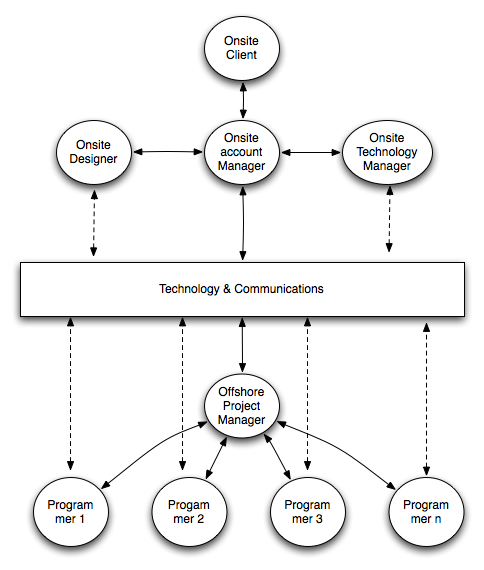
A smart person would immediately point out that this is very hard to achieve. You cannot just have Technology & Communications to manage a bunch of renegade Indian programmers. That’s true. I agree. But that was take 1. Let me add in more details. As in Google’s approach picture, the smart programs in the middle also constitute – monitoring and controlling programs which watch the hardware for any failures. Also, the client is never in direct contact with the Programmers in a real world outsourcing model. So, adding in these details to the picture now looks like this:

Oursourcing Model: Take 2

Like I said, the most important part is going to be the Technology & Communication part. That is the central nervous system of the whole outsourcing model. I am pretty sure a lot of people are implementing outsourcing in the above mentioned way, but my leaning in this model is towards – how dispensible the programmers can be if you have a very sound Tech & Comm system. I have nothing against any programmers and I do want to keep the programmers I work with, but in this dire times nothing is long term and it would be selfish of me to expect a programmer to work for me for a long period of time. So, all this sytem does is to facilitate an easy transition of programmers into and outside the system. It doesn’t replace programming. If one programmer leaves, we need to replace him/her with another programmer. But this system enables to add any skilled programmer to the team and run with it.

So, what constitutes Technology & Communication area? Here is the list of things in my experience that have worked.

Communication:

1. Project Management tool: I have seen people managing the whole project with just an Excel sheet – just like they do their personal finances. On the other hand a lot of people use tools with varying complexity. I have tested out many and I don’t have any particular preference. The systems I have used lacked in some features I was looking for. But over all, here is what I would look for in a Project Management tool.

  • Team Management (Groups, Skills matching etc)
  • Time Management (Calendars, Available timings etc)
  • Messaging System (Email, Voice, Conferencing etc)

2. Monitoring & Tracking: These tools haven’t caught up yet. This is the reason why I believe that any system which does all these would be a custom built system. Because not many project management tools provide tracking & Monitoring.

  • Time Tracking & projections
  • Money Tracking & projections
  • Code Tracking & projections
  • People tracking & projections
  • Progress tracking & projections

Technology:

  1. Code repository: SVN
  2. Dynamic/Collaborative Documentation: Wikis
  3. Bug/Issue Tracking: Bugzilla
  4. Easy dev setup environments: Using opensource tools

We have worked very hard in the past 6 months to build this and to make things work in this ideal way at ruminal. So, far we have been partially successful but as we grow I think it’s possible that one day we will have a system along these lines where irrespective of how the market is on the other end, the system will be smart enough to raise flags on time so that the project keeps progressing.

Having said all this, I am still figuring all this out. I would love to have any input or feedback you might have to offer.

Patterns of Dualism

We all live in a dualistic world. The Philosophy of Dualism has been proposed long time back in Indian Vedanta Philosophy. It’s called Dvaita. The concept is very simple, but hard to remember and use to our advantage. In simple terms it just states that – we perceive (actually our sensory perceptions) our reality in the form of ‘subject’ and ‘object’. This is the basic logic behind it. Now everything is built on top of it and it can get very complex that we become un-aware of it.

Below are some patterns I have consistently come across in my perception. These things are nothing new. We all know these. Just like we have ‘Design Patterns’ in Computer Science, we also can find patterns in dualism. Here are some:

1. Rise and Fall

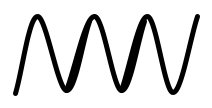
This pattern just states that whatever goes up, will come down and vice versa. You can try to observe this around you. The stock market, population growth patterns, traffic etc. Any data you take, you would see this pattern embedded within it.

Rise and Fall
Rise and Fall

What is important to note is in this rise and fall, everything is advancing towards the future or moving forward.

2. Big and Small

This is very easy to see. In any scenario or situation – there is someone who is big or with power and there is someone who is small or powerless. And and in most of the cases, there is always a tussle going on between these two entities.

Big and Small
Big and Small

We see this every where in our society. The middle east conflict, the Sri Lankan Sinhalese & Tamil conflict, the minorities in India, US. This is prevalent everywhere. The division may be based on power, money, population etc – but the pattern is same. One group is Big and another Small. We are so obsessed with this pattern that we make folklore & mythological stories based on that. Example: David and Goliath, Kauravas and Pandavas.  We love to root for the underdog.

3. The Choice Paradox

This one is a little complicated. These are the mental locks or physical situations we get into where there is no way out. This is ambivalence that results after two equally opposite values try to pull us in either directions. This is most powerfully experienced at the person level as compared to the previous two which play out much more at the society or group level.

Examples: The things that make us happy can also make us sick. Chocolate. Some morally questionable activities may give us more joy. We have a common name for this pattern called Catch-22

choiceparadoxThese are few which I see around me. As I said, there are many more patterns and I am pretty sure you may see them or come across them. Let me know if you have any and I will add them here.